Episodes / Leverage First Growth / No. 595
Reinventing Marketing Education through AI
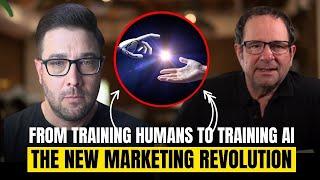
Join host Roland as he sits down with Richard Lindner, president of Scalable.co and DigitalMarketer.com, to explore how AI is transforming marketing education and business strategies.


With guest Richard Lindner
Listen instead and the audio keeps playing while you browse the site.
In this episode
The write up
So the question I asked Richard Lindner, my business partner and president of Scalable.co and DigitalMarketer.com, was really simple. We talked about how those two businesses have been rebuilt around AI and what people listening can take from that. Digital Marketer is done training humans as the way it sells education. When I described buying a course for a set price and then going through it on your own, he said we're almost universally over that. And he said, even where we're not, the market is.
That didn't mean courses are dead or that the frameworks behind them are worthless. Richard argued the opposite. He said the instructional design at Digital Marketer, which is what makes those courses work in the first place, is worth more now because you can use it to train AI that does the work for the client. Then he closed with a challenge that applies whether or not the threat in your market is AI. He said, figure out how you would be disrupted. And then disrupt yourself first.
Two businesses, two levels of AI
Richard said that AI is changing both businesses to similar degrees, but differently, with Digital Marketer changing slightly less. He said Digital Marketer is going to be what I think he called a done with you AI application, and Scalable is going to be done for you. It was a little shorter episode, so we spent most of the time on Digital Marketer.
I asked whether it's just one to many, or one on one as well. Richard said the one on one work will continue, but at a more consultative level, and that one on one work is still going to be AI powered. I said the part that is going away is the part where you buy a course and then go consume it on your own.
The courses become the training data
He raised the obvious worry himself. One strategic advantage at Digital Marketer is that the team can figure out what works and is good at instructional design, which means frameworks and trainings that are easy to take in and that move people from one place to another. If the courses go away, does that advantage go with them? He said no, because AI is so much easier to train than a person.
The courses will still exist, and clients will still be able to go through them, but they won't have to. I asked whether that makes the courses "more as a knowledge base than a product," and Richard agreed. The plan is to use them to train agents and GPTs, then give clients instructions for using those GPTs to build customized GPTs of their own, trained on their own companies.
Walking through one job to be done
I asked him for a specific example, so we asked: what's the job to be done? He chose Leads on Demand, which is the program Digital Marketer asks most people to start with. He said the job is, I need more leads. Under the old model, the client first had to learn how to write a problem statement ad, then run it through atomic testing, and then go do all of that.
Under the new model, they get an onboarding GPT that asks them questions and produces the profile of the company. Richard said this replaces the hours of videos on building a customer avatar, getting from the customer avatar to an ideal client profile, and writing your before and after. It's all done in there. They end up with the customer avatar, the ideal client profile and the product positioning sheet, all built in the frameworks from Digital Marketer.
I stopped him there because I wanted it to be clear for everybody listening. A GPT is just a mini app. I wanted to confirm that the first one is a get to know you GPT, a separate one that feeds into the next one. He said yes. Then they build their own GPT from copy and paste instructions and upload the documents that the first GPT produced. Richard said it takes three documents and a couple of questions, and it gives back 50 problem statement ad options in a couple of seconds. Then they run a quick Facebook test, upload the results, and so on.
Richard said that after about three or four GPTs, some built by Digital Marketer and some built by the client, they would have updated positioning. They'd have tested the ads to be sure they spoke to an actual problem their ideal client had, they'd have a lead magnet, and they'd have written the follow up series. So you're going from leads to conversion. And because it's done with you, you can still work with the experts and coaches at Digital Marketer.
The questions I pushed on
I asked about the price, and Richard said that lab members get access to all of the GPTs. As for cost, he thinks it runs in the 29 to $49 a month range depending on the level of access. The bigger systems that build out what he called basically automated marketing are $5,000 a year right now, and he said that's going to go up quickly to $10,000 a year. He said they already have 36 custom GPTs that members get, because they've been training them on their trainings for about the past six months and rolling them out to premium members. The full system has been in beta with a few members, who were paying nowhere near that price. He said it's going to roll out this month.
My main question was about friction. I felt like this was asking clients to learn how to build a GPT. Richard said that was their biggest concern too: is this going to be hard for them? He said Digital Marketer tends to have more tech savvy people. But they still made it a step one, step two, copy and paste job and tested it extensively. Members are building their custom GPTs pretty quickly, with no problems.
Then I asked what tools they're using besides ChatGPT. He said Manus. They loaded all of their products and all of their core training into Manus. They also told it the customer journey they want people to go through, what they want them to do and the outcome they want. Then they asked it how they could restructure everything so that the GPTs produce that result with as little learning as possible. As Richard said, "we don't want the client to have to really learn anything unless they want to."
What a business owner should do with this
I ended by asking how a business owner could use any of this, including one that sells a physical product. Richard went back to a mindset rather than a tactic. He said that at 37signals and Basecamp, the internal process was that they would disrupt themselves before somebody else did. That's a mindset, and he thinks they tore down and rebuilt their products, their code and so on about every six months. He said he's been working from that mindset for the past year or 18 months as he saw AI coming.
His challenge for anybody listening came down to a handful of questions.
- What could disrupt your business, and who could do it?
- If you were a competitor coming into your market, how would you disrupt you?
- How would you rebuild the business to protect it from that?
- What would have to be true about the value you add for the disruption not to matter?
- How would you become so valuable to your client that they wouldn't look at that competitor?
He went on to say that he applied this to his own company. Could clients go around Digital Marketer, skip it and go straight to an AI? He said yes, they could. But they wouldn't have the frameworks. That's why Digital Marketer is still valuable, even though there was a tool that could have badly disrupted it. He also said that in a physical product business, it's worth asking what the disruptor is. It may not even be AI. It might be tariffs. But he said the exercise is the same. For Digital Marketer and Scalable, the threat they were planning around was AI, not really a specific competitor.
I told Richard I loved it, and I thought it was super helpful for everybody. Here's how I'd put it. He started with a question: what is the company genuinely good at? Then, does that edge survive the disruption? Then he rebuilt the product around the answer. So if you're running a company, ask that before a competitor or a change in the market asks it for you.
I said I'd like to come back in another episode and go deeper on the different AI models and what's happening with them.
Written from the recording of this episode of Business Lunch.
Show notes
Welcome to a new episode of Business Lunch! Join host Roland as he sits down with Richard Lindner, president of Scalable.co and DigitalMarketer.com, to explore how AI is transforming marketing education and business strategies. This episode is perfect for entrepreneurs, marketers, and business owners looking to understand how to leverage AI tools to streamline operations, create marketing assets, and stay ahead of technological disruption.
Highlights:
"We are almost universally over traditional training."
"How do we disrupt ourselves before someone else disrupts us?"
"AI is so much easier to train than a person."
"We want the client to have zero learning unless they want to."
CONNECT
• Ask Roland a question HERE.
RESOURCES:
• 7 Steps to Scalable workbook
• Get my book, Zero Down, FREE
To learn more about Roland Frasier 👉 https://msha.ke/rolandfrasier/
Connect with me on social:
Free tools that go with this one
- 1RGR100 growth readiness scoreTen minutes on how fast the business can actually grow, and a one page 90 day sprint to move it. Exit Ready measures how sellable you are. This measures how fast you can grow.rgr100.lovable.app (opens in a new tab)
- 2Leverage ScorecardA three minute score on how much of your growth runs on other people's money, resources and time.getleveragescore.com (opens in a new tab)