Episodes / Dealmaker's Playbook / No. 622
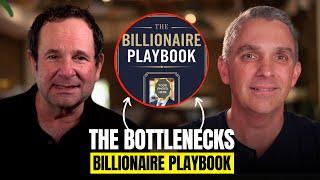
The Bottlenecks Billionaire Playbook: How the World’s Richest Build, Scale, and Keep Their Fortunes
In this week’s episode of Business Lunch, Roland Frasier and Ryan Deiss continue breaking down the “Bottlenecks” framework, the 11 proven playbooks that billionaires use to grow, protect…
Listen instead and the audio keeps playing while you browse the site.
In this episode
The write up
Every September Forbes publishes its list of the 400 richest Americans. This year more than 70% of them, 71% in fact, are self made, up from 67% last year. So Ryan Deiss and I spent this episode talking about how they did it and how a business owner could do the same thing at a smaller scale. The newcomers are not the flashy app designers or the celebrities. They're data labelers, energy exporters, freight platforms and coffee huts. Not one of the 14 newcomers came from social media.
We worked through it and came up with a framework that we're calling bottlenecks. There are 11 wealth engines that we see the people on that list pulling. What we landed on was that there is a commonality to all of them. Every one of the 11 is a version of the same four primary steps. One, identify the opportunity. Two, add value through transformation. Three, aggregate to scale, mostly through acquisition or roll up. And last but not least, exit at a higher valuation. Ryan and I did not like all of these equally. We had some disagreement on where the real money is.
Why the list is now mostly self made
The context matters. Total wealth on the list is a record 6.6 trillion. The cutoff to get on this year was a record high of 3.8 billion. The 14 newcomers added a collective 113 billion.
So I asked Ryan, is this a proof point for opportunity being more accessible, or is it just harder to get rich with no capital and no connections? He said it's all leverage, and that there's so much wealth being created so quickly now that somebody can do in a matter of years what it used to take a lifetime to do. I said I think it's the democratization of access to the tools that create wealth. You used to need a railroad or an oil refinery. Now you just have to have a computer.
Then I asked him, would you rather inherit a billion and protect it, or would you like to start with zero and build five? He said he'd probably do the second thing even if it was half as much, because he's more of a builder than a capital allocator. His warning to me was that you'll see a lot of people who are builders who get the money, move into capital allocation, find out they're not very good at it and lose it all.
Own the small bottleneck, not the monopoly
The first play is the one that the framework is named after. That's what Edwin Chen did with Surge AI. He built his wealth controlling labeled data, which is the human verified data that AI models train on. If you want to do this for the rest of us, the play is to identify a scarcity, acquire the undervalued operators around it, professionalize them with compliance, enterprise contracts and recurring revenue, and then go court the infrastructure buyers. That's what I described as buying in the three to four multiple range and exiting at 10 to 12.
Ryan's point was that you've got to be careful of the giant market because it's hard to control the bottleneck. He'd rather look at the second and third order players, which is what he was talking about in his example. He said we've got the client who does underground tanks for the generators that go in data centers. His point was that it's a hyper specialized company and nobody thinks about it.
That's where I pushed back a little bit. I had already said, that's kind of what we're saying. We're talking about mini bottlenecks and not monopolies, because the monopolies are our acquirers. But my caveat was that there is demand for this tank business and it doesn't have a lot of transformation available to jump the multiple. A medical transcription company, you could take that and reposition it as training data for AI labeling companies, and those companies would pay a hefty premium for that. You could make money with either of those. You just won't get the same size outcome.
So I asked him, would you rather own a bottleneck in AI or in something stable like utilities? Ryan's answer was that he'll take the stable thing. Give me the doubles and singles. He doesn't want to be in a trend, because then you're up against everybody. I agree with him. I said on the show, I don't trust the trendy one.
The plays we liked and the ones we did not
On order flow, Robinhood was the example, and I said it's kind of sketchy how they make money. Ryan said he'd be very nervous about this model because it starts to look like skimming. His test for any brokerage is, is what you're adding to this transaction anything other than controlling access? Because if all you are is a toll booth, the two parties will figure out a way around you. I said there's a company we worked with that is an intermediary between people who need to get rid of dirt and dump truck owners. They built this marketplace. They added AI automation and they're paid a fee on each connection. I think that's true value.
On the tools, I said I want to be a tool maker every time. The smaller play would be to acquire SaaS companies in the 5 to 10 million ARR range and bundle them in an AI DevOps suite. Ryan's caution was that tech is not a moat, especially with AI. If you've got something that could be a feature in somebody else's dev cycle, then that business is going to go to zero pretty fast. Your only moat is going to be a lot of users.
We both like the boring businesses. We both like energy. Ryan's complaint was that boring businesses are being sold on social media as safe and easy, and neither is necessarily true. Don't equate boring to easy, as Ryan put it. If you can't add value, you've got nothing but an investment. On the energy side, Ryan's point was that nobody's going to decide that light, heat and cooling are not necessary, and that there is opportunity to rebrand companies in that stack towards whichever industry needs them now. That one appealed to me in particular.
There were two plays that we don't want. On buying IP and defending it with demand letters, this is the one where I said it feels like more taking than giving. Ryan said most of the people that are making money there are lawyers who are basically just trolling. On scarce resources like water rights, I said it feels a little predatory. Ryan said he doesn't see an opportunity to add any value there.
Tax strategy, kept simple
Then there's qualified small business stock. Basically, if you set it up properly, you can exclude an amount of up to $10 million per shareholder in gains if you hold on to it for five years. Ryan said that we were able to use a variation of that when we sold a company recently, and it turned out to be a big win.
Then Ryan asked a question he called a bit off topic: when does somebody need to think about any of this? Ryan's watched a lot of owners who are building this crazy stuff while tripping over dollars to pick up dimes. My answer is, if you have an exit in your playbook, it's really simple with QSBS. The donor advised fund side I don't like, because you've given up control, and I can tell you charities won't give it back. I've had it both ways and I prefer simple now. I will give up some benefit for a rock solid strategy that's easy to unwind. Generally, I think 10 million in actual net worth is where the complicated planning really starts to make sense.
What to do with it
The C in bottlenecks is capital cycling. That means buying with seller financing, SBA loans and earn outs, improving the business, then refinancing. That's basically what we do at Epic. Ryan's take was that every business at scale becomes a recruiting agency and a bank, and we should all be striving to be capital allocators.
Then I asked Ryan for his favorite. He chose pick and shovel provider to a big trend through an existing boring business repositioned, because if the trend changes, you still have a good business. I like energy, and then the bottleneck businesses. I think tax structuring and capital cycling should be applied across all of them, but I think it is probably a combination of three or four of these that creates this giant opportunity.
Ryan closed by saying if you are in business, you are probably already doing most of one of these. The gap is rethinking and repositioning towards this higher scale model. "You're probably closer to a billion than you think," Ryan said.
Written from the recording of this episode of Business Lunch.
Show notes
In this week’s episode of Business Lunch, Roland Frasier and Ryan Deiss continue breaking down the “Bottlenecks” framework, the 11 proven playbooks that billionaires use to grow, protect, and multiply wealth.
From AI driven acquisitions to tax optimized exits, this conversation dives into the strategies that separate ordinary entrepreneurs from long term empire builders. You’ll hear how the world’s wealthiest think about capital allocation, scaling “boring” businesses, and structuring companies for massive, tax efficient exits.
Whether you’re scaling your first venture or managing a growing portfolio, this episode is a tactical deep dive into how to think, and act, like a billionaire.
Key Takeaways
• Tech Is Not a Moat: With AI making innovation easy to copy, your real advantage is distribution and users.
• The QSBS Advantage: How the Qualified Small Business Stock exemption can eliminate up to $10M (or more) in capital gains per shareholder.
• DAFs & Charitable Strategy: Donor Advised Funds can combine tax savings with long term impact, if structured correctly.
• Boring Businesses, Billionaire Results: Logistics, energy, and real estate can quietly create generational wealth when value is added and scaled.
• Capital Cycling: Why the world’s best investors (like Blackstone and Berkshire) act like banks, recycling capital and compounding returns.
Episode Highlights
Memorable Quotes
“If all you are is a feature that someone else could build, you don’t have a business, you have a countdown clock.”
“Boring businesses aren’t boring when they compound quietly into billions.”
“It’s not what you make, it’s what you keep.”
“Billionaires don’t think like operators; they think like capital allocators.”
Mentioned in This Episode
- Qualified Small Business Stock (QSBS), U.S. tax exemption strategy
- Donor Advised Funds (DAFs), Philanthropic and tax planning vehicles
- Ross Perot Jr. Logistics real estate
- Dutch Bros, Scalable retail model example
- Blackstone & Berkshire Hathaway, Capital cycling and compounding models
Listen If You’re
- A founder or investor learning to structure smarter deals.
- A CEO or operator ready to scale beyond execution into capital allocation.
- A strategic thinker who wants to play the long game in business and wealth creation.
Connect
- Hosts: Roland Frasier & Ryan Deiss
- Podcast: Business Lunch with Roland Frasier
- More at: businesslunchpodcast.com