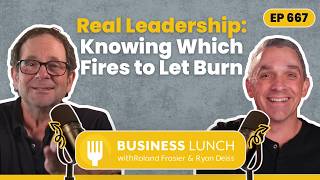
Episodes / Owner Mindset / No. 668
Why 75% of Founders Regret Selling (and How to Exit Without Losing Yourself)
A Hartford Financial study found that 75% of business owners regret selling their company.


Listen instead and the audio keeps playing while you browse the site.
In this episode
The write up
Ryan Deiss brought a number in. He had come across a Hartford Financial study that said that 75% of business owners regret selling their company, and his reaction was that it sounded about right, because it matched what he had noticed among people we know who have sold. Ryan and I have both exited businesses. We talked about the identity that leaves with the company, the promises the buyer made that didn't ultimately work out the way they were supposed to after the close, and what the people who are happy with it are doing differently.
Where we landed is that the loss is real and you are choosing it. But most of that damage can be avoided if the next thing exists before the cutoff. I called that fulfillment continuity. And Ryan said, knowing what you're exiting to is just as important as knowing what you're exiting from.
What the study said, and what surprised me
Ryan walked through each of the reasons the study gave for why this happens: identity crisis, loss of purpose, disappointment with buyers, generally poor planning. He says we see sellers who get the cash and spend it, or they're bored and they decide they want to be investors now, and they put money in every little business and they lose it. He also said that more than half the owners who sell swoop back into the business.
That last one surprised me. A lot of these companies can't be taken over again. The people who came in and tried to run them have decimated them, and they don't let go until there's not much left. I've watched people we worked with come back after private equity bought the company and not be able to get it back. The time has passed, the thing that worked doesn't work anymore, or the audience was left to wither too long. I'm curious how many of the ones who come back and try to get it going again are successful in that and how many go on to fail.
A little bit later, Ryan added a detail that explains part of it. By his recollection of the stat, 40 something percent of them never left. They stayed in some capacity, so they were already in the building.
The identity that leaves with the business
For me, I think the biggest identity that I ever left was practicing law. I founded my firm, I was managing partner, and I was operating in it for about 14 years. If somebody asked what I did, I was an attorney. I was less an attorney than I was an investor, but investor sounded too vague. The explanation ran too long and it didn't carry the same status that I felt like I wanted to have. When I left that, I had other businesses, but none of them was me, and I was kind of at sea.
Ryan's version came when we sold Traffic and Conversion Summit to one of the Blackstone companies. He said that even though we still owned DigitalMarketer, he had actually exited mentally from DigitalMarketer too, because the plan was to sell the rest of it. He had not thought enough about what his Monday through Friday would look like. So he was lost and purposeless. He said his wife would tell you that he wasn't much fun to be around, and that it took him probably a year and a half to get his mojo back. But he was also careful to say that he would much rather sell for a ton of money and lose his sense of identity than have the business fail and lose both.
I think we felt it at different times. It was most acute for me later, when the pandemic happened and the buyer just shut the event down, because all the people used to come to us to get access to that distribution channel and then it was gone. Ryan said he felt kind of relieved and a sense of closure by then. But I think his point is that if you've got co founders, they can go through the same thing, but they might be on different schedules. So he said it helps to just ask each other how you are doing, kind of like a married couple might go to counseling when there isn't anything wrong. We've sent people to professionals that help with business marriages more than once.
What buyers tell you before the close
I remember the dinner where we got serious about that sale. The message was, this isn't going to change. This is what you're doing now. You are going to continue to do that. We're just going to expand it. But it was pretty clear within two months that they didn't want us meddling in a lot of it. They wanted us to show up and lend our personal brands and talk about things. We had multiple written contracts for continuing to do things in the company, and it still wasn't what we thought it would be. They bought it, and I think that's their right.
What I asked Ryan was, do you think they know that's not going to happen? His answer was that if you connected them to a lie detector, they would probably pass. They are in the moment believing it. They want it to be true. He put the split down to some arrogance on the acquirer side, but also to the diligence process itself, where the seller spends all this time trying to convince the buyer their company is great, and the buyer is trying to convince you it's broken. He also said he believed them himself, and he should have known better.
I see that as less extreme. The fights are over addbacks, the working capital peg, and the multiple. More to the point, they have to get a return on their investment. They're typically going to have debt behind them, outside investors, or both. So they're going to own the decisions they're accountable for, rather than hand that back to you. It's not going to be status quo. You should know that. Ryan tells founders to keep the earnout from getting too big for this reason, and to let themselves be pleasantly surprised instead of disappointed.
Fulfillment continuity
So how do we fix it? Here's how I think about the fix. I would ask, what percentage of your personal fulfillment comes from the business? If you're at a hundred percent, you're in trouble the day it gets cut off. Most of these deals don't keep you involved more than about a year, even if there's a three or four year earnout. A mutual friend of ours sold at a good price and told us that when he walks into the office now, it's awkward, and they're like, we don't want you here.
So you build threads that run past the closing. What are the things that you know you want to be doing? For me, it's 15 to 20 hours a week of pickleball, scheduled and non moveable. That has to happen. Then I've got 500 plus synthesizers and instruments that would take me three lifetimes to learn. So that's another thing. I get to lose at chess to my wife. I get to travel: 158 countries so far. I think that I would be happy with about 60% business and 40% everything else. But I don't think I could go past that point where business loses voting control of my life. I think that if I did, I would miss the battle, in a healthy way. By that I mean the negotiation.
Ryan pushed it further and said you have to know what it is specifically about the business that fulfills you. That's different for all of us. For him, it was the creative, zero to one part. He said, once a builder, always a builder. The happy sellers he knows moved into a new daily activity, not just a new label. Golf and philanthropy don't scratch that itch for him, which is why he asked, about the Scalable company, what if we just didn't sell it, kept the goose, sold the eggs.
What to do with this before you sell
The shift has to exist before the cutoff. If you plan for that, you're still going to feel the loss, but it's going to be significantly less impactful than if you don't have other threads that you can lean on while you're finding out what replaces the business. If you don't do that, here's what I see a lot: the addictions and infidelities and too much partying and depression, and deciding that you're a venture capital investor and funding every startup that your buddies bring you. That's where I see people falling if they don't have some plan for that transition. What I said on the show was, you have the ability to finance your downfall.
Ryan's step is practical, so it works whether or not you sell. He said that every year he goes through the work that he liked and didn't like. He fires himself from his job, writes a new job description, and rehires himself. I think his point was that money is only helpful to you as a tool if you know what you're building towards. Asking the question now is going to help you have a better job today, and it's also going to help you have a better exit later.
Written from the recording of this episode of Business Lunch.
Show notes
In This Episode Of Business Lunch: A Hartford Financial study found that 75% of business owners regret selling their company. Roland Frasier and Ryan Deiss have both lived it, and they get personal about what the wire does not fix: the identity you give up with the business, the buyer promises that rarely survive the close, and why more than half of sellers wind up swooping back in. Then the way out: fulfillment continuity, the threads you build before the exit so you are not adrift after it.
If you have exited a business, share in the comments what surprised you most about life on the other side.
Roland Frasier:
Instagram: https://www.instagram.com/rolandfrasier/
LinkedIn: https://www.linkedin.com/in/rolandfrasier/
TikTok: https://www.tiktok.com/@rolandfrasier
Facebook: https://www.facebook.com/RolandFrasierPage/
More: https://msha.ke/rolandfrasier/
Ryan Deiss:
Instagram: https://www.instagram.com/ryandeiss/
LinkedIn: https://www.linkedin.com/in/ryandeiss/
Scalable: https://www.scalable.co
Free tools that go with this one
- 1Scale & Exit AssessmentAbout five minutes. A score out of 100, what your business is worth today and after the fixes, and the 11 value killers capping the number, in a 15 page report.score.scalable.co (opens in a new tab)
- 2Exit Ready ScoreA three minute read on how a buyer would size up your business and where you are most exposed.getexitreadyscore.com (opens in a new tab)